On this page
Talk to a Local Tree Expert in Your Area
Removal, trimming, stump grinding and storm cleanup
Call (888) 495-6008- Tree removal
- Tree and bush trimming
- Stump grinding
- Emergency storm work
- CallFree, 24/7
- Enter ZIP5 digits
- ConnectLocal tree expert
Key takeaways
- Whose tree is it? The owner is whoever's land the trunk stands on. A tree on the property line is usually shared.
- A storm usually means insurance pays, not the neighbor. A healthy tree that falls in a storm is generally treated as an accident, and your own homeowners policy pays for your damage. Tree removal is often capped at about $500 per tree and $1,000 per incident.
- A visibly dead or neglected tree usually shifts the cost to the neighbor. If the owner knew or should have known the tree was dangerous, the neighbor can be responsible.
- You can usually trim branches back to the property line, at your own cost. Most states do not let you harm the tree or cut past the line. You generally cannot force a neighbor to remove a healthy tree.
Whose Tree Is It? Start With the Trunk
General information, not legal or insurance advice. Rules differ by state, and policies differ by insurer. Check your state law and your own policy, or ask your insurer or a local attorney, before you act.
The first question decides everything else: where does the trunk stand? A tree generally belongs to the person whose land the trunk grows on. The Texas State Law Library states the rule that way and notes there can be exceptions. Branches and roots that cross the line do not change who owns the tree.
- Trunk on your neighbor's land: it is your neighbor's tree, even if the whole crown hangs over your yard.
- Trunk on your land: it is your tree, even if it leans over a neighbor's fence.
- Trunk on the property line: the tree usually belongs to both owners. California law, for example, says a tree whose trunk stands partly on two properties belongs to both. Get your neighbor's agreement in writing before you remove a shared tree.
A survey or your property deed shows the line. A fence is not always on the line, so check before you argue over a boundary.
Who Pays When a Neighbor's Tree Falls on Your House
The answer depends on why the tree fell. Courts and insurers look at the cause first.
| What happened | Who usually pays | Why |
|---|---|---|
| A healthy tree falls in a storm or high wind | Your homeowners insurance pays for damage to your house and for removing the tree from the damaged structure | Storm damage is treated as an accident ("act of God"): no one is at fault |
| A dead, diseased or visibly leaning tree falls | Your neighbor may be responsible, and their insurance may pay | The owner knew, or should have known, the tree was dangerous (negligence) |
| A tree falls after you told your neighbor in writing it was dangerous | Your neighbor is more likely to be responsible | A written warning is evidence they were on notice |
| A tree falls because a crew cut it badly | The crew may be responsible, and its insurance may pay | The worker may have caused the failure |
| A tree falls with no damage, onto open ground | The tree owner removes it | Nothing to claim |
Source: Insurance Information Institute, Allstate, NC State Extension and Cornell LII [1][4][12][13].
In either case, take photos before anything moves, write down the date, and call your insurer. Your insurer pays you first in most cases. It may then try to collect from the neighbor's insurer (this is called subrogation), and you may get your deductible back. The Insurance Information Institute puts it this way: you are insured no matter who owns the tree. The claim goes to your own insurer.
The "act of God" rule. When a healthy tree falls because of lightning, wind or a storm, the law usually treats it as an accident. An act of God is a severe natural event that no person is responsible for. The neighbor is usually not at fault, so you claim on your own policy.
The negligence rule (failing to take reasonable care). A neighbor can be at fault when they ignored an obvious hazard. Examples are a dead tree, big cracks, a lean that got worse, rot at the base or a warning from an arborist. A written letter or email to the neighbor, with photos, makes this much easier to prove. North Carolina courts, for example, ask whether the owner let a dangerous tree stay standing. A dead or visibly dying tree, or one that leans hard toward the next lot, counts against the owner.
Does Homeowners Insurance Cover Tree Removal?
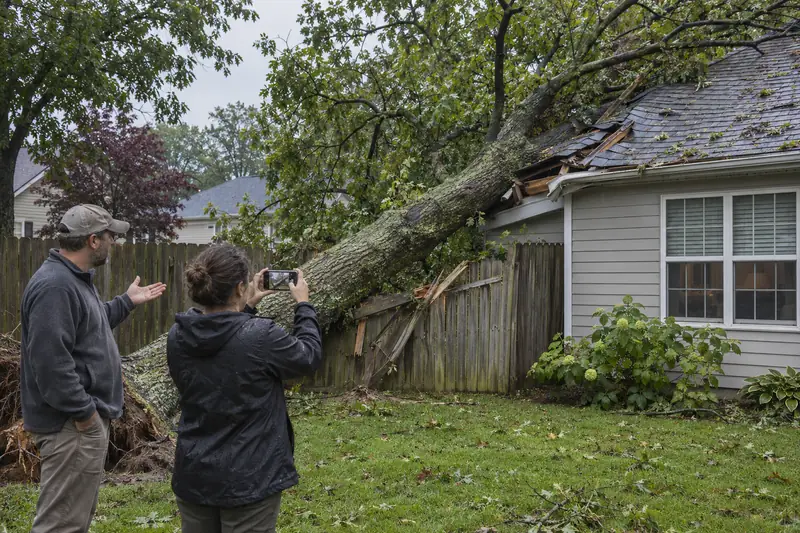
Homeowners insurance usually covers sudden damage from a fallen tree to a covered building. It often pays to remove the tree from that building too. It does not usually pay to remove a tree that has not fallen or one that is healthy but unwanted.
| Situation | Usually covered? |
|---|---|
| A tree falls on your house, garage or other covered structure in a storm | Yes: repair of the damage and removal of the tree from the structure |
| A tree falls in your yard and hits nothing | Usually no. Removal is typically the owner's cost |
| A tree falls on a fence or shed | Usually paid under "other structures" cover, which has its own limit. A tree blocking a driveway is sometimes paid for removal |
| A tree falls on a car | Your auto policy usually pays, under comprehensive cover (the part of an auto policy for damage that is not a crash) |
| A leaning or dead tree you remove before it falls | Usually no. Insurers see it as maintenance |
| Tree roots damaging pipes or the foundation | Often not covered. Check your policy |
| Damage from a tree you neglected | Possibly denied if the insurer says you should have acted |
Source: Insurance Information Institute, GEICO and Allstate [1][2][4].
Policies cap what they pay to clear a tree. The Insurance Information Institute says a homeowners policy pays to remove a tree that hits an insured building. The limit is generally about $500 to $1,000, depending on the insurer. GEICO says many policies limit debris removal to $500 per tree and $1,000 per incident. United Policyholders says most policies cover up to $500 or $1,000 for reasonable tree debris removal. Your own policy sets the real limit, so ask your agent for the "tree debris removal" limit.
How much will insurance pay for tree removal? Repair of the damaged house is covered up to the limit in your policy. You pay your deductible, which is the part of the claim you pay first. Removing the tree is usually capped at about $500 to $1,000. Removing a fallen tree that hit a house costs $1,500 to $6,350 (about $3,950 on average). With a $1,000 cap, you would pay about $2,950 at that average price. Some policies pay more, so check yours.
| Situation | Typical cost | Range |
|---|---|---|
| Fallen tree in the yard | $1,320 | $950 – $2,500 |
| On a fence | $1,875 | $1,290 – $3,290 |
| On a house | $3,950 | $1,500 – $6,350 |
| On power lines | $4,250 | $1,950 – $8,200 |
Source: GoTreeQuotes emergency tree removal cost guide [14].
Tree height changes the price too. A 15 ft fallen tree costs about $150 to $190 to remove. A 25 ft tree costs $400 to $600, and a 35 ft tree $900 to $1,400. A 50 ft tree costs $1,400 to $2,100.
Your Neighbor's Tree Hangs Over Your Yard: What You Can Do
Overhanging branches are the most common neighbor tree dispute. The usual rules:
- You may trim branches back to the property line. Texas, Maryland and Massachusetts all say a neighbor can cut branches that cross onto their land, back to the property line. Maryland and Massachusetts say the same for roots. That is the usual rule across the United States.
- You usually pay for it. A court is unlikely to order a neighbor to pay or cut unless the branches harm you or your property.
- Do not go onto the neighbor's land to cut without permission. Cutting from your side only is the safe way to stay within the line.
- Do not cut the tree so much that it dies or becomes unstable. Cutting so much that the tree dies can make you liable (legally responsible for the cost). The Texas State Law Library notes that a neighbor can be sued for injuring the tree. Washington, Oregon and California can triple the damages for wrongly cutting a tree on someone else's land. California counts only double if the cutting was accidental or the person truly believed the land was theirs. Check your state's rule before any heavy cut.
- Roots follow the same idea. You can usually cut roots back to the line, but heavy root cutting can harm the tree.
Check your state's rule before cutting a large limb. Some states treat a damaging overhang as a nuisance and let a court order the owner to act.
Can You Force a Neighbor to Remove a Tree?
In most places, no, not just because you want the tree gone. A healthy tree on your neighbor's land is their property. You can usually force action only when the tree is a real hazard or is causing damage.
What helps your case:
- Talk first. Many disputes end with a friendly conversation and a shared quote.
- Put the hazard in writing. Send a dated letter or email with photos. Say what you see and why it worries you.
- Get a certified arborist's opinion. A written assessment costs $100 to $300, and some cities ask for one before they approve a removal.
- Call the city. Ask whether it has a rule for dead or dangerous trees.
- Try mediation, where a neutral person helps both sides agree. Ask your county or city if it runs a program and what it costs.
- See a lawyer last. A court may act when a tree harms you or your property. Small claims court is for smaller amounts: the California limit is $12,500, and your state sets its own.
What to Do Right After a Tree Falls
- Stay away from power lines. Treat every wire as live. Call the utility and 911 if a line is down.
- Get everyone out of a damaged room. Do not go back in if the roof or walls shifted.
- Take photos and video of the tree, the damage and the property line. Take them before anyone moves anything.
- Call your insurer right away. Ask what it will pay before you hire a crew for the full removal. Save every receipt.
- Make temporary repairs, such as a tarp over a hole in the roof. Your policy expects you to protect the home from more damage. Keep receipts and send them to your insurer.
- Tell your neighbor. Share photos and your claim number, and ask them to contact their insurer too.
- Get a written quote for removal. The crew should list what is on your side of the line.
Do not hire a crew that knocks on your door after a storm and asks for a large payment up front.
Cost to Remove a Fallen or Dangerous Tree
Removing a standing tree costs $400 to $1,200 for most trees, and an emergency job costs 25% to 50% more. A tree on open ground can cost less than a standing one, since nobody has to climb it. One lying on a house or wire costs more. Stump grinding is extra, at $100 to $500.
Check Your State Law and Your Policy
These are usual patterns across the United States. State law differs on overhanging branches, boundary trees, notice and damages, and some states set special rules for harming a neighbor's tree. Policies differ on limits and exclusions. For your case:
- Read your homeowners policy for "trees," "debris removal" and "windstorm."
- Ask your insurance agent what your policy pays for tree removal.
- Look up your state's rule on overhanging branches and boundary trees on a state law library or bar association website, or ask a lawyer.
- Ask the city whether a permit is needed to remove a tree, since cities set their own rules for protected trees.
General information only, not legal or insurance advice. Ask your insurer or a local attorney about your case.
Frequently Asked Questions
Who pays for neighbor overhanging trees?
You usually pay to trim branches back to the property line on your side. The neighbor generally does not have to pay unless the tree caused damage or they ignored a hazard. Trimming a 40 foot tree costs about $350 to $650, and a single limb $75 to $400.
Whose insurance pays if a neighbor's tree falls on my house?
Usually yours, even when the tree was your neighbor's. A healthy tree knocked over by a storm is treated as an accident. Your homeowners policy pays for the damage, minus your deductible (the part you pay first). It covers tree removal up to its cap, often $500 to $1,000. If the tree was visibly dead or diseased and the neighbor was warned, your insurer may go after your neighbor's insurance.
How much will insurance pay for tree removal?
Usually about $500 to $1,000, and only when the tree hit a covered structure. GEICO says many policies cap debris removal at $500 per tree and $1,000 per incident. The damage to the structure is covered up to your dwelling limit, minus your deductible. Removing a fallen tree off a house averages about $3,950, so check your policy's limit.
Can I force a neighbor to remove a tree?
Usually not a healthy one. You can push for removal when the tree is dead, diseased or leaning toward your house. Send a written notice with photos. Get an arborist's opinion ($100 to $300). Ask the city for help, try mediation and see a lawyer last. Some cities require owners to remove dangerous trees.
Can I cut my neighbor's tree branches that hang over my yard?
Yes, back to the property line, as Texas, Maryland and Massachusetts all say. You usually pay for it yourself. Do not cut onto their land. Cutting so much that the tree dies can make you liable. Washington, Oregon and California can triple the damages, so check your state's rule first.
Who is liable if a tree falls down?
Usually no one when a healthy tree falls in a storm. Each owner claims on their own policy, and the tree's owner removes it from their own land. The owner can be liable if the tree was visibly dead, diseased or leaning, and they knew or should have known. A written warning with photos strengthens a claim.
Does homeowners insurance cover a tree that has not fallen yet?
Usually no. Insurers treat removing a leaning, dying or healthy tree as maintenance, which standard policies do not cover. They cover sudden damage from a fall. Removal of a standing dangerous tree costs $400 to $1,200 for most trees.
Can my neighbor sue me if my tree falls on their house?
Possibly, if the tree was visibly dead, diseased or leaning and you knew or should have known. A healthy tree that a storm knocks over is usually not your fault, and your neighbor's own insurance usually pays. Your insurer may defend or pay a claim, so call it right away. Ask a local attorney about your case.
Talk to a Local Tree Expert in Your Area
A free call connects you with a local tree expert for removal, trimming, stump grinding or storm cleanup. Enter your ZIP code and get connected, 24/7.
Sources and How We Checked
Rules vary by state and by policy. The sources below were checked in November 2026.
Full method and data sources: how we calculate tree service prices.
Sources
- Insurance Information Institute (Triple-I). "If a tree falls on your house, are you covered?" (iii.org)
- GEICO. "Does Homeowners Insurance Cover Tree Removal? What You Need to Know." (geico.com)
- United Policyholders. "What's UP with Trees, Shrubs, and Landscaping Insurance Coverage?" (uphelp.org)
- Allstate. "Fallen Tree Damage and Homeowners Insurance." (allstate.com)
- Texas State Law Library. "Neighbor law: trees." (guides.sll.texas.gov)
- Maryland People's Law Library. "Problems with neighbors FAQ." (peoples-law.org)
- Mass.gov. "Massachusetts law about neighbors and trees." (mass.gov)
- California Civil Code section 834 (california.public.law)
- California Civil Code section 3346 (california.public.law)
- Washington RCW 64.12.030 (app.leg.wa.gov)
- Oregon ORS 105.810 (oregon.public.law)
- Cornell Legal Information Institute. "Act of God." (law.cornell.edu)
- NC State Extension. "Tree Fall Liability: Who Is Responsible for Property Damage?" (content.ces.ncsu.edu)
- GoTreeQuotes. "Emergency Tree Removal Cost Guide."
- GoTreeQuotes. "Cost of Fallen Tree Removal."
- GoTreeQuotes. "Arborist Cost Per Hour."
- Breasy. "Tree Removal Cost: $400-$1,200, Complete 2026 Guide."
- Insurance Information Institute. "Settling insurance claims after a disaster." (iii.org)
- TreeLaws.org. "Tree Laws by State: How the Rules Differ (2026 overview)." (treelaws.org)
- California Courts Self-Help Guide. "Small claims." (selfhelp.courts.ca.gov)
- HomeGuide. "How much does tree removal cost?"
- Omar Tree Service (Kansas City). "Will my homeowner insurance cover preventive tree removal?"
Sources checked November 2026.