On this page
Talk to a Local Tree Expert in Your Area
Removal, trimming, stump grinding and storm cleanup
Call (888) 495-6008- Tree removal
- Tree and bush trimming
- Stump grinding
- Emergency storm work
- CallFree, 24/7
- Enter ZIP5 digits
- ConnectLocal tree expert
Key takeaways
- Remove a tree that is dead, leaning with soil heaving, split down the trunk or rotting at the base. Trim one that has a few dead branches or storm-broken limbs.
- A dying crown, large cracks, mushrooms at the base and a trunk that is hollow or soft are the warning signs arborists weigh most.
- An arborist check costs $100 to $300. Removing a tree costs $400 to $1,200 for most trees, and an emergency removal costs 25% to 50% more.
- Trimming a tree costs $200 to $800, and it saves trees with dead branches or crowded growth. It does not fix a rotten trunk or dead roots.
How to Tell if a Tree Needs to Be Removed
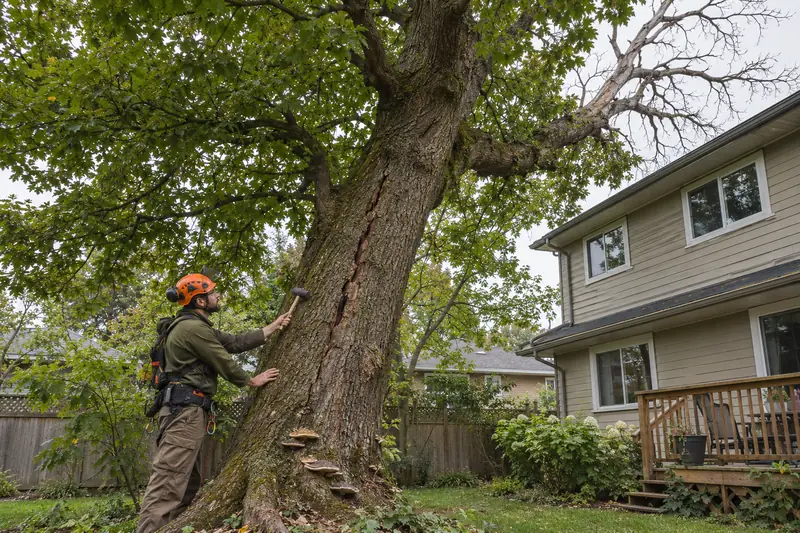
A tree needs to come out when it is likely to fail and something could be hurt. That could be a house, a car, a play area, a power line or a sidewalk. Arborists weigh two things: how likely the tree is to fail and what it would hit. A leaning tree in the middle of a field is a low risk. The same tree beside a bedroom window is a high risk.
Check these seven areas. Walk all the way around the tree and look from the top down.
1. Dead or Dying Branches Across the Crown
The crown is the leafy top of the tree. A few dead branches are normal. Dead wood across a large share of the crown is a warning sign. Extension guides say a tree with more than half its crown damaged is likely past saving. Ask an arborist to look well before that point. A thin crown is often the first sign of a struggling tree. This is called dieback. The top and center branches carry fewer leaves than the rest of the tree.
What to do: if the dead wood is on a few branches and the trunk looks sound, trimming usually solves it. If the whole crown is thin or bare in summer while neighbors are green, a dying or dead tree is likely.
2. Cracks, Splits and Cavities in the Trunk
Look for long vertical cracks, a split where two stems join, and holes or dark hollows in the trunk. A crack that runs a long way up the trunk, or a split fork, can let the tree break in wind. A hollow does not always doom a tree, but a large cavity weakens the trunk.
What to do: call an arborist. A deep crack or a split fork on a large tree near a building often means removal or a heavy structural prune.
3. A New Lean or Heaving Soil
A tree that has leaned for decades and grew that way is usually stable. A tree that begins to lean after a storm is not. Raised soil on the side opposite the lean, a cracked patch of lawn or roots lifting out of the ground mean the roots have moved.
What to do: treat a sudden lean as urgent. Keep people and cars away from the fall zone, and have a crew look at it in the next few days.
4. Mushrooms, Fungus and Soft Wood at the Base
Mushrooms or shelf-like fungus on the trunk or around the base can mean the wood inside is rotting. Soft, crumbly or hollow-sounding wood is another sign. Root rot works from below: the tree may look healthy above ground until it leans or dies back.
What to do: an arborist can test for rot. Fungus on a tree with a healthy crown still raises the chance of failure, since the damage can be inside.
5. Damaged or Exposed Roots
Cut, crushed or exposed roots weaken a tree. Common causes are construction, trenching for a pipe or cable, and soil piled around the trunk. Roots that lift a driveway or a foundation are a separate problem and may be a reason to remove or to prune roots.
What to do: root pruning costs about $300 to $750, and an arborist can check the roots as part of an assessment. A tree that lost a large share of its roots may fail months later.
6. Peeling Bark, Dead Bark and Sap Oozing Out
Bark that peels off in sheets or falls away to show bare wood points to disease or pests. So does dark sap oozing from the trunk. Specific problems include oak wilt (a fungus that kills oaks), Dutch elm disease, emerald ash borer (a beetle that kills ash trees) and bark beetles. The Arbor Day Foundation lists these and tells owners to start with the county Cooperative Extension office. Its Master Gardener volunteers can help diagnose a pest or disease.
What to do: call your county extension office or a certified arborist. Ask a local arborist when to prune oaks. In Texas, the state forest service says to avoid pruning or wounding oaks from February through June, since beetles carry oak wilt to fresh cuts.
7. Storm Damage
A snapped top, a split trunk, large broken limbs and a tree knocked sideways are all signs of storm damage. University of Maryland Extension says that if 50% of a tree is damaged, it probably should be removed. Missouri, Utah State and Purdue extension guides use the same half-crown test for storm damage. A split trunk points the same way, say the Missouri guides. Broken limbs that hang in the tree over a house, driveway or sidewalk are urgent.
What to do: keep away from any tree touching a power line, and call the utility. Photograph damage before cleanup if you plan to file an insurance claim. Home insurance usually covers a neighbor's tree that falls on your house, with a limit on the removal cost.
Remove, Trim or Get a Check: Quick Guide
| What you see | Usual answer | Typical cost |
|---|---|---|
| A few dead branches, trunk sound | Trim | $200 – $800 |
| Crowded branches rubbing together | Prune | $300 – $650 |
| Limb touching the roof or leaning over the house | Trim the limb | $200 – $500 |
| Thin crown, uncertain cause | Arborist check | $100 – $300 |
| Mushrooms at the base, soft wood | Arborist check, then remove if rotten | $100 – $300, then $400 – $1,200 |
| Deep crack or split fork on a large tree | Arborist check, often remove | $100 – $300, then $400 – $1,200 |
| New lean with raised soil | Remove, urgent | $400 – $1,200, +25% to 50% if urgent |
| Whole crown bare in summer | Remove | $400 – $1,200 |
| Storm split, half the crown gone | Remove | $400 – $1,200 |
| Healthy tree you do not like | Keep, or plan removal | See the removal price |
Source: University of Maryland Extension, Missouri Extension, Utah State Extension and HomeGuide for the signs; Breasy and GoTreeQuotes for the costs [1][2][3][12][13][14].
When Trimming Can Save the Tree
Trimming works when the problem is in the branches, not in the trunk or roots. A crew can remove dead, diseased or broken branches. It can thin a crowded crown to let in light and air. It can also shorten a limb that leans over a roof. Regular trimming also lowers the chance of limbs falling in storms.
Trimming does not save a tree with:
- Rot or fungus in the trunk or roots. Removing branches does not stop the decay.
- A systemic disease such as advanced Dutch elm disease or oak wilt. Cutting infected branches early can slow it, but not cure it.
- A trunk split or a major lean. Cuts above ground do not repair roots.
For a 40 ft tree, a trim costs about $350 to $650 and removal $500 to $1,100. A trim is worth it when the tree can recover. It is not worth it when the tree will likely fail within a few years.
What an Arborist Check Costs
An arborist is a tree specialist with training and, in many cases, a certification. For a tree you are unsure about, a visit costs less than any removal.
| Service | Cost | Notes |
|---|---|---|
| Tree inspection (a short visit) | Free to $150 | $70 on average. |
| Arborist assessment | $100 – $300 | Written opinion on health and risk. |
| Consultation (up to 5 trees) | $70 – $150, then $20 – $50 per extra tree | Advice on care and risk. |
| Written arborist report | $450 – $600 for one tree | 12 to 30 pages. Some cities ask for one before they approve a removal. |
| Tree removal | $400 – $1,200 for most trees | $200 to $550 under 30 ft; $1,800 to $3,500+ over 80 ft |
| Emergency removal | 25% – 50% more than planned | $1,320 average for a fallen tree in the yard |
Source: GoTreeQuotes arborist, report and emergency cost guides, and Breasy [13][14][15][17].
A risk assessment looks at how likely the tree is to fail and what it would hit. A tree that could hit a person is far more likely to get a removal recommendation. A tree that would fall into an empty yard is not.
Who Can Tell You
The cheapest option that answers your question comes first.
- County Cooperative Extension office. Staff and Master Gardener volunteers answer most plant health questions and can help diagnose a disease or pest.
- A certified arborist. The International Society of Arboriculture (ISA) advises hiring an arborist when a tree is dead, dying or an unacceptable risk. An ISA Certified Arborist has passed an exam covering all aspects of tree care. Ask for a written opinion on a tree you plan to remove, and ask for proof of insurance. Then call the insurance company to check the policy.
- Your city's forestry or planning office. Some cities protect large or older trees and ask for an arborist report before approving a removal. The city decides, and a report does not guarantee approval.
What Affects the Cost of Removing a Tree
Removal prices follow height, health, access and urgency. A dead tree costs about 10% to 25% more to remove than a healthy one, because dead wood is brittle and unpredictable. A tree near power lines costs more, and an urgent or storm removal costs 25% to 50% more.
Frequently Asked Questions
How do you know when a tree needs to be removed?
When it is dead or dying, leans after a storm with raised soil, is split down the trunk or rots at the base. It also needs to come out when it could hit a house, car or power line. A few dead branches alone mean a trim, which costs $200 to $800. A tree you are unsure about gets an arborist check for $100 to $300.
How can you tell if a tree is dying?
Look for a thin crown, no new leaves in spring and bare branches in summer. Peeling bark, mushrooms at the base and dieback from the top down are also signs. Dead branches over more than half the crown are a strong sign. Scratch a small twig with a fingernail. Green under the bark means it is alive, and brown means it is dead. Check several twigs. Drought, pests and disease cause many of these signs.
How can you tell if a tree will fall?
No one can be sure. Warning signs include a new lean, raised soil or lifted roots, and a large crack or split. A hollow or soft trunk, fungus at the base and heavy dead wood are signs too. Risk also depends on what is below. A tree over a house is a higher priority than one in an open field.
What are the warning signs of tree stress?
Wilting or scorched leaves, small or sparse leaves and dieback in the crown are common signs of stress. Drought, root damage, pests and disease are common causes. Water deeply in dry weather, and ask your county extension office or an arborist to find the cause.
What is the 3-30-300 rule for trees?
It is a city-planning guideline, not a test for whether your tree must go. It says people should see 3 trees from home and live where 30% of the land is under tree canopy. They should also be within 300 meters of a good green space.
Should I remove a tree that is leaning?
A lean that formed over many years is often stable. A lean that appears after a storm, with raised soil or broken roots on the other side, is urgent. Have a crew look at it within days, and expect removal to cost 25% to 50% more if it is an emergency.
Can a dying tree be saved by trimming?
Sometimes. Trimming saves a tree whose problem is dead or diseased branches, and it does not save one with rot in the trunk or roots. A trim costs $200 to $800 for most trees, and an arborist can tell you which case you have for $100 to $300.
How much does it cost to have an arborist look at a tree?
A short inspection costs free to $150 and averages $70. A written assessment costs $100 to $300. A full report for a city permit or an insurance claim costs $450 to $600 for one tree. Removal itself runs $400 to $1,200 for most trees.
Talk to a Local Tree Expert in Your Area
A free call connects you with a local tree expert for removal, trimming, stump grinding or storm cleanup. Enter your ZIP code and get connected, 24/7.
Sources and How We Checked
Warning signs come from university extension guides, the Arbor Day Foundation and the International Society of Arboriculture. Prices come from published 2025 and 2026 cost guides. Estimates are for planning only. A written quote after the crew or arborist sees the tree is the final price.
Full method and data sources: how we calculate tree service prices.
Sources
- University of Maryland Extension. "How do you decide when to remove a tree?" (extension.umd.edu)
- University of Missouri Extension. "First Aid for Storm-Damaged Trees" (G6867) (extension.missouri.edu)
- Utah State University Extension. "Addressing Tree Damage Following a Storm." (extension.usu.edu)
- Purdue University Extension. "Trees and Storms: Understanding Damage, Risk and Recovery." (purdue.edu)
- Sacramento Tree Foundation. "Ask an arborist: Is my tree still alive?" (sactree.org)
- Penn State Extension. "Tree Diseases that Create Hazards." (extension.psu.edu)
- Arbor Day Foundation. "Tree Health Issues." (arborday.org)
- TreesAreGood.org (International Society of Arboriculture). "Why Hire an Arborist?" (treesaregood.org)
- Texas A&M Forest Service. "Prevent the spread of oak wilt in Texas." (tfsweb.tamu.edu)
- Iowa State University Extension. "Sap is flowing from a pruning cut on my maple tree." (yardandgarden.extension.iastate.edu)
- U.S. Forest Service Research. "Measuring the 3-30-300 rule to help cities meet nature access thresholds." (research.fs.usda.gov)
- HomeGuide. "How much does tree removal cost?"
- Breasy. "Tree Removal Cost: $400-$1,200, Complete 2026 Guide."
- GoTreeQuotes. "How Much Does an Arborist Cost?" and "Arborist Cost Per Hour."
- GoTreeQuotes. "Arborist Reports."
- GoTreeQuotes. "Tree Risk Assessments."
- GoTreeQuotes. "Emergency Tree Removal Cost Guide."
- GoTreeQuotes. "Tree Trimming Cost Guide" and "Tree Pruning Cost."
- Insurance Information Institute. "If a tree falls on your house, are you covered?" (iii.org)
Sources checked November 2026.